Bello Bourdane, president of the Cameroonian Volleyball Federation, speaks candidly about the sport’s resurgence, ongoing legitimacy battles, and ambitious plans to reach the 2028 Olympics
The president of the Cameroon Volleyball Federation (FECAVOLLEY) faced the media in what could be addressed as an end of year allocution. In an interview granted to the press, Bello Bourdanne evaluated the year’s performance beginning with the latest event which was the CAVB Zone IV Club champions league.
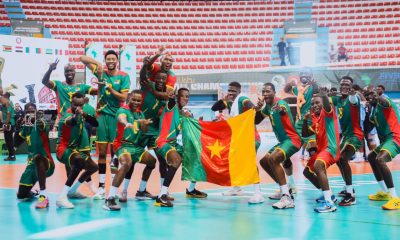
The recent Zone 4 Champions League in Douala served up more than just sporting drama. Two Cameroonian clubs, Litto Team (women) and PAD (men), claimed continental honours, but for Bello Bourdane, president of the Cameroonian Volleyball Federation (Fécavolley), the victories represented something deeper: proof that Central African volleyball is finally coming of age.
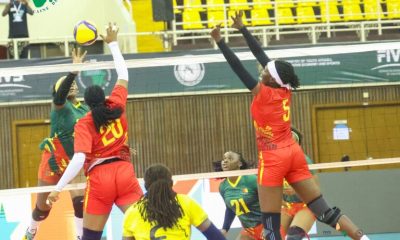
“The level of play was truly remarkable,” Bourdanne reflects. “Teams showed technical and mental preparation worthy of major competitions. But it also confirmed that Zone 4 is one of the most competitive on the continent, which means we need to work harder on training, club professionalisation, and nurturing young talent.”
The Money Problem
When asked what Central Africa needs to dominate the continent—and perhaps the world—Bourdanne doesn’t hesitate. “Resources,” he says bluntly. “As Zone 4 president, our biggest challenge is simply moving teams from one country to another. Imagine trying to get squads from Chad to Congo. It’s enormous. It requires serious funding.”
For years, Zone 4 has been under looked by both the continental confederation and the international federation. That’s changing. Following a recent presidents’ seminar, the International Volleyball Federation decided to give regional zones greater prominence. Soon, zone competitions will become mandatory qualifiers for continental championships, forcing governments to take them seriously.
“This means we’ll finally have some resources to help teams compete at zonal level, making them more competitive,” Bourdanne explains. “In our zone, we’re capable of fielding five national teams out of eight countries. Cameroon, given its position, helps other nations by providing quality coaches to raise standards. Within four years, we aim to have all eight zone countries competing in youth categories, and eventually at senior level.”
Still, international federation support won’t be enough. Sponsors remain elusive, particularly in Cameroon where, Bourdanne suggests, potential partners are discouraged by “disinformation campaigns, intimidation, and other tactics” circulating daily. He hopes that multiplying competitions will boost volleyball’s attractiveness and draw commercial backing across the region.
Beach Volleyball’s Second Coming
Beach volleyball in Cameroon had been struggling. Recently, though, the national team strung together impressive victories in Congo, sparking talk of a renaissance. Bourdanne is cautiously optimistic but identifies a fundamental problem: the athletes themselves don’t yet believe in beach volleyball.
“We’re trying to encourage them because, more than indoor volleyball, beach volleyball offers a better living when you go professional,” he says. The federation has launched a national beach tour and a zonal tour, attempting to show athletes they can make proper money. Unlike indoor volleyball, beach tournaments always include prize money—often substantial amounts.
“There’s no beach volleyball without prize money, and the prizes are high,” Bourdanne notes. “At every level, you earn enough to plan ahead.” The federation recently certified ten specialist beach coaches through the international federation’s Empowerment programme. The challenge now is convincing athletes to specialize in beach rather than indoor volleyball. “They haven’t yet grasped the importance of specializing. That’s the real difficulty.”
A Formation Crisis
Development sits at the heart of Bourdanne’s project, and here his assessment is stark. Cameroon currently has ten training centres using ten different coaching methods. Worse, coaches routinely skip developmental stages, rushing athletes who have the right physical build for volleyball without proper foundational work.
“A volleyball player takes four years to train properly,” Bourdanne explains. “You’ll see coaches who, because an athlete has the right body type, will burn through the stages. We’re trying to organize trainers into an association so they can standardize training methods together.”
The consequences show up at international competitions. Cameroon’s men’s and women’s teams consistently reach podiums without quite dominating. “Our athletes have gaps in their foundational training that can’t be filled once they’ve reached a certain age,” Bourdane admits. “We sometimes lose on details that, had the basic training been good, would ensure our athletes’ strength made us the best in Africa.”
Training isn’t just technical. Psychological preparation represents another glaring weakness. “Cameroon can win a set easily, then there’s an emotional spike,” Bourdane says. “The next set, you’re behind because you’ve lost concentration, and you’re scrambling to catch up. We want athletes to manage their emotions from one action to the next, one set to the next, one match to the next, staying focused on the final objective: victory.”
Three Training Hubs
The federation plans to establish three development centres in Yagoua, Douala, and Yaoundé. Yagoua—a city in the Far North—offers something special: the right physical build for women’s volleyball. “Kenya did this,” Bourdane notes. “They went to areas with the right body type to develop volleyball, because the athletes had natural capacities for good volleyball.”
The Yagoua project is already well advanced, as is Douala’s. Yaoundé lags slightly behind. The concept is straightforward: gather the best regional athletes at a central training hub where qualified coaches with proper pedagogy can work with them. The federation will monitor progress according to programmes set by trainers, with annual evaluations.
Each year, a national gathering will bring together athletes from all three centres. The best will be retained for specialist monitoring. “That’s how we’ll build a framework of age groups with excellent training, the right body type, and readiness to join our clubs for the next stage of their careers,” Bourdane says.
These hubs aim to standardise skills, technique, and volleyball movements—passing, receiving, attacking, defensive positioning—creating what Bourdane calls “made-in-Cameroon volleyball, a melting pot of everything done best in Brazil and Europe.” Fortunately, a Brazilian coach is currently working in Cameroon, already training women’s coaches. The same approach will soon apply to men’s coaching.
The Legitimacy War
For nearly two years, Bourdane has faced what he terms a “war of legitimacy.” Are there two volleyball federations in Cameroon? “No,” he states firmly. “Only one federation exists: the one elected on 20 January 2023, recognized by the competent authorities; The Ministry of Sports, the National Olympic Committee, the African Volleyball Confederation, the International Volleyball Federation, and the International Olympic Committee.”
What exists, he says frankly, are isolated maneuvers led by former federation president Abouem à Boul, who is suspended from the worldwide Olympic movement until the end of 2032 for failing to appeal within the required timeframe. “He challenged the International Volleyball Federation’s recognition of my election at the Court of Arbitration for Sport. We intervened, provided all elements, and he was defeated.”
The Court of Arbitration for Sport—a legal institution created by the International Olympic Committee in 1994 to resolve sporting disputes—represents a supreme authority. Cameroon, which recognizes CAS, should abide by its decisions as happens elsewhere.
Still, the rival group continues organizing competitions under the federation’s name. Why does the federation allow it? “We’re not allowing it,” Bourdane insists. “Two days ago, we issued a statement warning all club presidents, officials, and athletes who venture into clandestine competitions that they’ll simply be suspended from Cameroonian Volleyball Federation activities.”
Businesses sponsoring such competitions face denunciation to authorities—particularly public enterprises, which the federation will report to the Special Criminal Court for making public funds available for illegal competitions. “We’ve communicated this. We don’t make much noise; social media doesn’t make a federation, work does.”
The problem, Bourdane admits, is that the federation cannot guarantee public order. When someone declares a public event, the federation cannot prevent them organizing. Private volleyball competitions are even welcome—they contribute to development. “But when you organize without authority, falsely claiming to represent the Cameroonian Volleyball Federation, you’re already breaking the law, and we’ll act.”
The Unpaid Prizes Saga
One persistent issue involves unpaid prize money for the 2023 Africa Cup of Nations. Some suggest rival administrators enjoy blessing from certain state authorities, pointing to this as evidence. Bourdane dismisses this as more disinformation.
“In 2023, I participated in all budgetary meetings at the Ministry of Sports for arbitration. We participated in sectoral meetings at the Prime Minister’s offices for these competitions—the normal process when a competition exceeds 100 million CFA francs in budget.” Representatives from Sports, Finance, and the Prime Minister’s office attended these meetings, documented in minutes. Budget arbitration was sent to the Secretary General at the Presidency. The response came back: payment to the right person, the only recognized federation, the only federation that organised the Africa Cup of Nations.
“It was under my stewardship that this championship was organised. You saw it. We took these Indomitable Lions to Egypt,” Bourdane says. “How could legitimacy possibly be granted to them by public authorities?”
What’s happening, he explains, is that certain people are using their administrative positions to spread disinformation and create blockages. In May 2025, the Secretary General at the Presidency wrote again to the Finance Minister asking about reimbursements and regularisation for the Cameroonian Volleyball Federation regarding 2023 international competitions. “Public authorities are following the file. Whatever the blockages, we’re following the file.”
Athletes should remain optimistic, Bourdane urges. “If I weren’t legitimate, why would I have received an advance from the same Ministry of Sports treasurer to pay hotels so that foreign countries visiting could leave without problems?” The federation is fighting to ensure the money gets paid soon, particularly given enormous senior objectives ahead. “How do you motivate children still waiting for prizes from the previous edition? That’s a challenge.”
Looking Ahead
The season’s end brings both reflection and forward planning. Elections loom. “We’re conscious we must organize elections,” Bourdane acknowledges. “The Cameroonian Volleyball Federation was the first to request, immediately after the Paris Olympics, permission from our supervisory authority to organize this election.” But the federation answers to dual oversight—the Olympic Committee and the Ministry of Sports. The ministry’s official response asked them to wait until the regulatory framework is established. “We’re republicans. We obey our supervisory authority.”
Meanwhile, work continues. Next season brings consolidation: fully organized national competitions with a stable calendar and modernized formats, better supervision, progressive professionalization of clubs. Youth training will intensify—coaches, referees, reactivated regional training centres, standardised coaching methods. Exploratory missions to certain countries will seek approved equipment at good prices to properly equip clubs and raise competition quality.
The big international appointments include the 10th edition of the Zone 4 Club Championship in the Democratic Republic of Congo. More important still are the men’s and women’s Africa Cup of Nations, both carrying enormous stakes reaching to 2028. The men’s championship in DR Congo will qualify teams for the 2027 World Championship and, crucially, the Olympics. Same for the women’s championship in Kenya.
“Cameroon aims to win both competitions,” Bourdane declares. “The top three in ranking go to the World Championship, but for the Olympics, only the winner qualifies. So we aim to win this competition.” Everything else—consulting administrators, revising the activity calendar—serves this goal: giving national teams more time to prepare for these critical deadlines in Cameroonian volleyball’s future.
Season’s Wishes
As the year ends, Bourdane’s wishes for the volleyball family are simple: health, success, and adherence to the activity schedule. “This year we occupied many places of honour at national team level. Among the U20s, both women and men, we were finalists. We aim to make Cameroonians smile.”
His hope is that Cameroon can finally reconnect with the sporting victories that have been missing for some years. After months navigating administrative storms while building foundations for genuine continental dominance, perhaps that wish isn’t so far-fetched after all.