By Giovanni Wanneh
Patrice Motsepe thought he had secured a financial lifeline by embracing a four-year Africa Cup of Nations cycle. Instead, his gamble has exposed him to political manipulation within his own ranks. As Morocco’s influence grows and former allies position themselves for Motsepe’s throne, the CAF president may have been outplayed.
All 54 member associations of the Confederation of African Football (CAF) are expected to vote, by mail, before Wednesday, October 28, on whether to endorse the proposed four-year AFCON cycle or opt for the more measured and widely expected alternative of retaining the tournament’s traditional two-year format.
Letters signed by CAF interim General-Secretary Samson Adamu were dispatched to the member associations, asking them to decide the fate of the competition. But for a decision of such magnitude to be reconsidered and potentially reversed, CAF president Patrice Motsepe must have seen something the public did not. He was reportedly misled by close allies who sold him the idea of a bigger, better AFCON under a four-year cycle, only for the grand proposition to turn out to be a load of rubbish.
In December last year, in Rabat, Motsepe announced that the biennial AFCON would move to a four-year cycle from 2028. At the time, he dismissed suggestions that CAF was being dictated to by either FIFA or European football’s governing body, describing such claims as “nonsense, absolute rubbish”.
Ten months later, on October 9, 2026, speaking at the CAF Strategy Conference in Cape Verde, Motsepe revealed that CAF was re-evaluating the decision and examining the possibility of retaining AFCON every two years, following strong feedback and in recognition of the tournament’s tradition and commercial importance.
When Motsepe assumed the presidency of CAF in March 2021, he was heralded as the clean pair of hands needed to restore financial stability and moral credibility to an organisation long troubled by corruption allegations. Backed wholeheartedly by FIFA president Gianni Infantino, he was presented as a reformer capable of elevating the continent’s flagship tournament into a world-class commercial spectacle while restoring confidence in African football’s administration.
Five years into his presidency, however, that narrative is facing serious challenges. Motsepe finds himself navigating a complicated web of geopolitical interests, political manoeuvring and personal ambition. The proposed transition to a four-year AFCON cycle, initially presented as a major component of the confederation’s long-term restructuring, has become a political liability. What was supposed to be a landmark reform now looks like a gamble that could collapse before it has even properly taken shape.
At the centre of the unfolding drama are Morocco’s growing influence within African football, FIFA’s calculations, and a succession battle involving individuals who were once considered Motsepe’s closest allies. The South African billionaire may have entered CAF believing that corporate experience and international connections would be sufficient to command the institution. He is now discovering that African football is governed by a different currency: the ability to understand where power really resides.
The Sovereign Fund Mirage
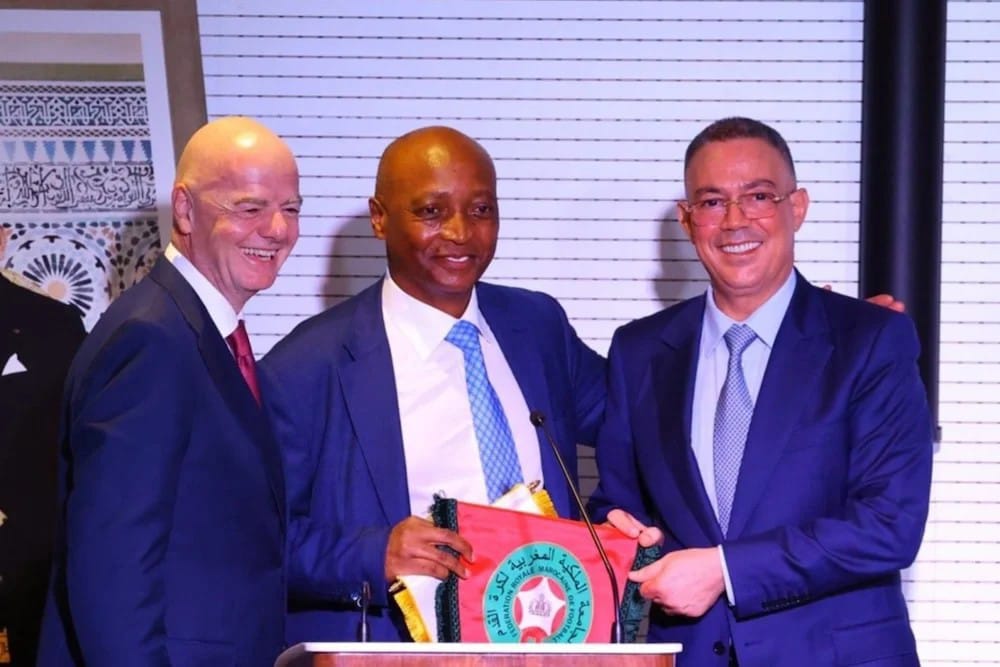
At the heart of Motsepe’s predicament is an extraordinary sequence of alleged negotiations involving Faouzi Lekjaa, the influential president of the Royal Moroccan Football Federation (FRMF), and FIFA’s Gianni Infantino.
The proposition, as described by individuals familiar with that discussion, was as lucrative as it was politically attractive. Lekjaa reportedly approached Motsepe with an extraordinary proposal: Morocco’s National Sovereign Fund would make available a financial package worth $1.4 billion to CAF. At a time when global sports broadcasting markets were becoming competitive and CAF’s operational expenses remained substantial, such an injection would represent an unprecedented financial opportunity for the confederation.
But the proposed arrangement reportedly came with a condition. In exchange for the financial package, CAF would have to reconsider its tournament structure and move towards a four-year AFCON cycle, with Morocco securing the hosting rights for the 2028 edition.
For Morocco, the ambition extended beyond the prestige of hosting another continental tournament three years after that of 2025. The country is preparing to co-host the 2030 FIFA World Cup alongside Spain and Portugal. Hosting AFCON 2028 would act as the perfect dress rehearsal.
For Motsepe, the prospect of securing $1.4 billion was difficult to ignore. The proposed arrangement offered the possibility of insulating CAF from financial uncertainty, strengthening its balance sheet and presenting his presidency as a commercial success. It was the kind of headline-making financial achievement that could have helped redefine his legacy.
However, beneath the apparent generosity lay a fundamental question: what else would CAF be surrendering in exchange for the money?
A four-year AFCON cycle represents a departure from a tournament structure that has sustained the confederation and many of its member associations for decades. It would also place the future of African football’s most important revenue-generating competition within a broader financial and political arrangement involving powerful external interests.
Patrice Motsepe, operating with the instincts of a corporate executive accustomed to negotiating major financial transactions, viewed the proposal as an opportunity to solve several problems simultaneously. He trusted that Lekjaa and Infantino were acting as constructive partners.
When the Price of Money Became Heavy
The true nature of the alleged arrangement became clearer as negotiations progressed.
According to an inside source, Morocco’s proposed financial commitment was not simply about changing the AFCON calendar and securing hosting rights. The sovereign fund arrangement equally carried another political expectation: CAF would have to align itself with Morocco in the ongoing AFCON final disputes before the Court of Arbitration for Sport (CAS) in Lausanne.
For Motsepe, this presented a far more complicated proposition, especially with the recent backlash the Confederation and its leader have come under.
CAF is a continental governing body representing 54 member associations, not an extension of any individual federation’s political or legal interests. Formally aligning the confederation with one member association in its disputes before an independent sporting tribunal would raise serious questions about neutrality.
It would also expose Motsepe to accusations that CAF’s decisions were being influenced by the financial and political interests of a particular member association.
Motsepe has long been associated with ambitions beyond football administration, including speculation about a possible future role in South African politics. Having built his reputation in business and philanthropy, he could hardly afford to be portrayed as a president whose decisions were dictated by foreign financial interests.
Initially, he reportedly resisted the pressure, attempting to establish a boundary between CAF’s institutional responsibilities and Morocco’s political ambitions. But the resistance did not last.
The Four-Year AFCON Set To Die on Arrival
The proposed transition to a four-year AFCON cycle was supposed to be one of the defining reforms of Motsepe’s presidency. Instead, it has become a source of political uncertainty, exposing the contradictions between CAF’s commercial ambitions and the economic realities of African football.
The overwhelming argument for moving AFCON to a four-year cycle has been driven partly by the demands of the international football calendar. European clubs have routinely complained about the frequency of the tournament, particularly when it coincides with the European domestic season. A four-year cycle would reduce scheduling conflicts, make the competition less frequent and potentially increase its commercial exclusivity.
But it is considerably less attractive when viewed from the perspective of African football associations.
For many of CAF’s 54 member associations, AFCON is a critical financial lifeline. Its commercial and broadcasting revenues help sustain the confederation’s operations and support the distribution of funds to national associations.
A biennial tournament also provides regular opportunities for sponsorship agreements, government investment and infrastructure development. For countries with limited domestic football revenues, these opportunities are particularly important.
The economic argument against a four-year cycle is therefore difficult to dismiss. Reducing the frequency of AFCON could create a financial gap for associations that depend on the tournament’s commercial ecosystem.
Motsepe’s challenge was to demonstrate that an alternative revenue model could compensate for the potential losses. A proposed sovereign fund arrangement, even one worth $1.4 billion, would not automatically guarantee long-term financial independence. More importantly, it would raise questions about the sustainability of an arrangement dependent on the interests and commitments of external political and financial actors.
The Cape Verde U-Turn and Midnight Mailshot
In mid-October 2026, during a CAF seminar in Cape Verde focused on African football’s performance at the 2026 FIFA World Cup, another bombshell dropped. Motsepe switched stands maybe, even quicker – than the great Muhammad Ali.
“We’ve discussed it over the last few days to say, we are looking at everything, including having AFCON coming back every two years. We’re very clear.” Motsepe stated.
The apparent reversal raised questions among observers. The answer, at least politically, may lie in the balance of power within CAF.
Lekjaa’s influence across the confederation, has become an important factor in the organisation’s internal politics. His ability to build alliances and mobilise support has made him one of the most influential administrators in African football.
Motsepe could not afford to underestimate that influence.
“An open and immediate vote on the four-year circle AFCON could also have turned a technical discussion about the tournament calendar into a public demonstration of political strength,” a close source revealed. Reason why, the process moved towards a written ballot.
Through CAF’s interim General Secretary, Samson Adamu, an emergency correspondence was dispatched to the 54 member associations, requesting that they submit their official positions through a written voting process by Wednesday, October 28.
A written ballot may be an administratively legitimate way of consulting member associations. Nonetheless, in an organisation where political alliances often determine the outcome of major decisions, the circumstances surrounding such a vote matter enormously.
For Motsepe, the process offered an opportunity to avoid a potentially embarrassing public confrontation.
Diallo’s Betrayal and the Battle for Africa’s Golden Seat
Beyond the controversy surrounding AFCON’s future lies an equally consequential struggle over the succession to Motsepe.
Another striking development has been the changing political position of Yacine Idriss Diallo, president of the Ivorian Football Federation.
Motsepe had reportedly invested considerable political capital in building relationships. Diallo was among. But as the balance of influence within CAF remains delicately poised, the calculations of individual administrators also appeared to change.
Diallo’s relationship with the South African president has become part of the wider succession conversation. His political positioning, and the possibility of an alignment with Lekjaa’s influential network, illustrate the nature of alliances within CAF especially at this crucial moment where the future of African football is at stake.
Generally – the emerging succession battle has brought prominent names into the conversation:
Samuel Eto’o, and Mauritania’s Ahmed Yahya are the other two who have shown interest.
In African football, loyalty can be temporary. Ambition rarely is. The reality is that some of the individuals who once appeared to be part of Motsepe’s political support structure may now be preparing to benefit from his weakening influence.
Why Biennial AFCON Still Matters
The argument for retaining a biennial Africa Cup of Nations is fundamentally economic.
European football operates within a different financial environment. Its leading associations enjoy substantial domestic broadcasting agreements, commercial sponsorships, developed club competitions and extensive grassroots infrastructure. For many European federations, the European Championship can be organised within a broader ecosystem that generates substantial income throughout the four-year cycle.
The situation is considerably different across much of Africa.
For numerous CAF member associations, the biennial AFCON provides one of the most important sources of financial opportunity. The tournament generates commercial and broadcasting revenues that support the confederation’s operations and contribute to the financial assistance distributed to national associations.
It also creates opportunities for host governments to invest in infrastructure, including stadiums, roads, hotels and other facilities.
For countries with limited resources, hosting AFCON can provide an important catalyst for development. A four-year cycle would therefore require a convincing alternative financial model.